Build your compliant battery signage kit in 30 seconds
Answer a few quick questions about your installation and we’ll show you exactly which labels you need to stay compliant with AS/NZS 4777.1:2024 and AS/NZS 5139.
Tick all that apply to your installation. This controls which optional labels are included in your kit.
Quick Setup:
Manual Options:
Note: The checklist below mirrors the CER labelling-related questions (and shows the matching shop label card beside each item). Your kit summary on the right is calculated from this list and your selections above.
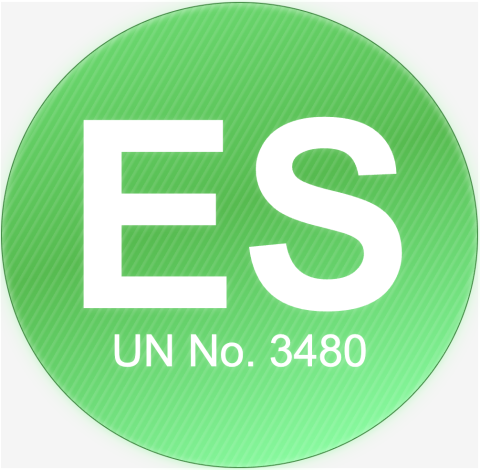
Is signage, consisting of circular, green reflector, with the letters “ES”, installed immediately on or adjacent to the meter box and switchboard, and is it readily available to be seen by approaching emergency workers?
Is the ES sign at least 100 mm in diameter and does it contain the United Nations number for the primary chemistry written below the “ES” lettering — for example, UN3480?
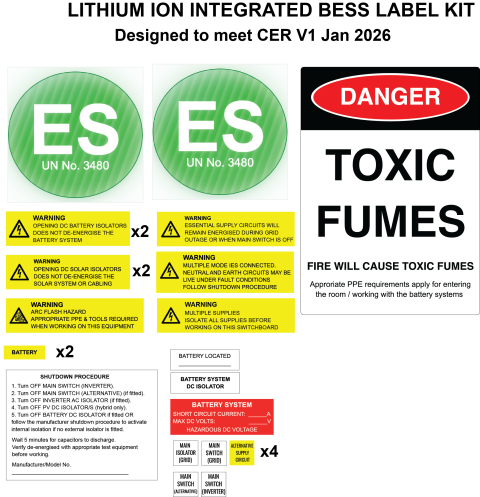
Has a warning label been installed at the main switchboard and all intermediate distribution boards to indicate a multimode inverter with alternative supply has been installed and to follow the shutdown procedure for safe isolation, and is the text “Neutral and earth circuits may be live under fault conditions” included?
Sign adjacent to the battery system stating: Battery System or BESS; correct short-circuit current (A); correct maximum DC voltage (V). Above DVC-A, also “Hazardous DC voltage”.
Sequential shutdown steps adjacent to PCE; visible from equipment operated in shutdown; terminology matches device labels; states that isolating PCE may not de-energise the battery.
As required by chemistry classification (AS/NZS 5139 Table 3.1) and your SDS: e.g. explosion, toxic fumes (fault conditions + PPE), arc flash above “minor” — adjacent to enclosure or on all room doors. CER lists these as separate questions (Integrated BESS 15–17 / PBS 19–21) because not every chemistry needs every sign.
CER Integrated BESS 15–17 ask for explosion, toxic-fume, and arc-flash signs only if your battery’s classification requires them (5139 Table 3.1, SDS, manufacturer). Many sealed lithium-ion integrated systems do not use the same placards as e.g. vented lead-acid — do not fit “every” hazard sign by default. Verify against Table 3.1.
CER PBS 19–21 (pre-assembled battery system) cover the same hazard themes for pre-assembled installs (e.g. separate inverter and battery enclosure). Signs are required only if classification / Table 3.1 and your SDS say so — not a blanket “fit every placard” rule for all Li-ion.
Vented or flooded lead-acid systems often fall into classifications where explosion and toxic fume warnings are required per Table 3.1. Confirm hydrogen / ventilation requirements with the SDS; signage must match fault conditions and PPE.
All signs and labels: durable for service life; UV-stabilised if in direct sun; fixed securely; English; legible letter size per location; indelible; visible from installed position.
Lucky you’re shopping with Plastic Tags: our standard materials and engraving are selected for real switchboard environments, so you won’t need to worry about this requirement.
Lucky you’re shopping with Plastic Tags: our standard materials and engraving are selected for real switchboard environments, so you won’t need to worry about this requirement.
SB 3
OptionMediumAS/NZS 5139:2019 Cl. 7.4, App. B Fig. B.2
BESS location plan
CER detail
If the Battery Energy Storage System is not easily located, is there a plan or drawing showing the location of the Battery Energy Storage System located at the main switchboard which includes the location of shutdown procedures?
If the Battery Energy Storage System is located adjacent (i.e. next to or adjoining without obstruction and within arm’s reach) to the switchboard and if multiple battery systems or BESS are installed, is there a sign for each that provides an identifiable number together with the total number of systems installed? For example, BESS 1 of 3?
Alternatively, if the battery/inverter system has been connected to a distribution board, has a sign containing the words “MAIN ISOLATOR (GRID)” or similar been placed adjacent to the isolator for the normal supply to the distribution switchboard?
Where the battery inverter connects to a distribution board: label on main and intermediate DBs — “Warning Multiple Supplies Isolate Inverter Supply at Distribution Switchboard at …”.
Remote from switchboard — isolation & identification
CER detail
If the battery / inverter is not within 3 m line of sight of the switchboard it is connected to: AC isolation device(s) that can be secured in the open position shall be adjacent to the battery/inverter to isolate supplementary and alternative supplies as applicable. Those isolation points must be clearly identified (labelling consistent with your shutdown procedure).
Questions about materials, engraving, or UV stability for your site? Contact Plastic Tags — we supply engraved plastic, stainless cable markers, and safety signage suited to switchboards and outdoor battery enclosures. CER references: Inspection checklist · Photo guide